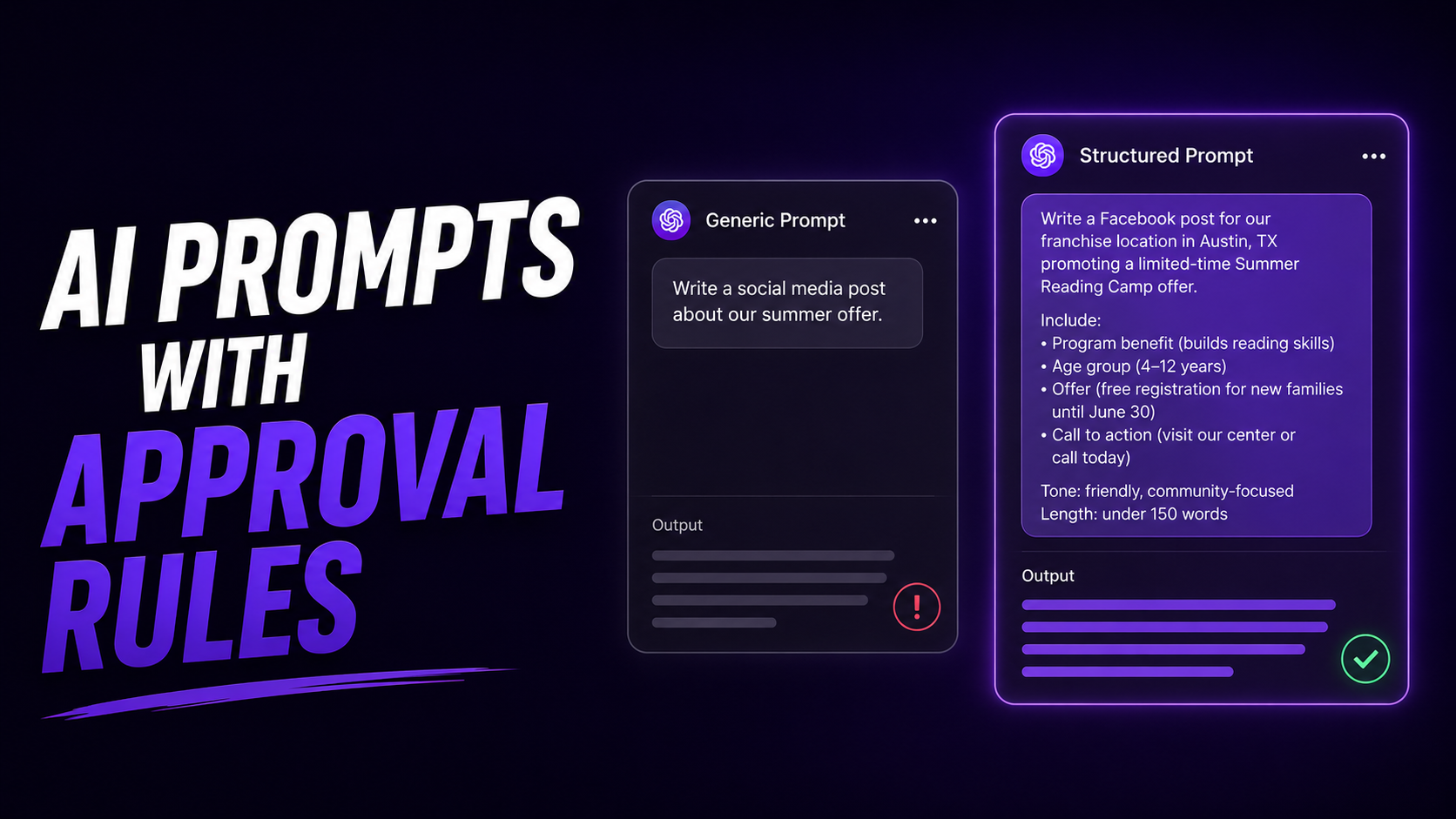
Franchise marketing teams are experimenting with ChatGPT, Claude, Perplexity, and Google Gemini to speed up content creation. The appeal is practical: a social post, email draft, review response, or ad variation can be produced in seconds.
But speed without structure creates problems. When team members across dozens or hundreds of locations generate AI-assisted content without clear prompts or approval rules, brand consistency erodes and compliance exposure increases.
For franchise systems, prompts alone are not enough. Marketing teams also need approval rules and custom AI workflows that keep generated content aligned with brand standards, legal requirements, local market needs, and campaign goals.
87%
of franchisees believe more AI tool use would improve their marketing performance
The State of Franchise Marketing report found that just 13% of franchisors offer no AI support to franchisees — most systems are already guiding AI usage in some form, which makes structured guidance essential.
How Franchise Marketing Managers Are Using LLM Tools Today
Most franchise teams begin with everyday content tasks that are repetitive but still need local detail — a back-to-school post for each city, a January membership email, paid search headlines for different service areas.
Common uses include social captions, email campaigns, review responses, and ad copy variations. Teams scaling this across locations can explore franchise AI workflow use cases for repeatable local marketing workflows.
Social Media Examiner’s 2025 AI Marketing Industry Report found that 90% of marketers use AI for text-based tasks, with idea generation, draft creation, and headline writing among the top applications.
90%
of marketers use AI for text-based tasks — drafts, captions, and headlines, the exact content types franchise teams generate daily
For franchise systems, frequent usage raises the stakes. If AI is used daily but prompts are inconsistent, content quality will vary by location and channel, the issue is not whether the tools are useful, but whether drafts are based on approved inputs and reviewed before publishing.
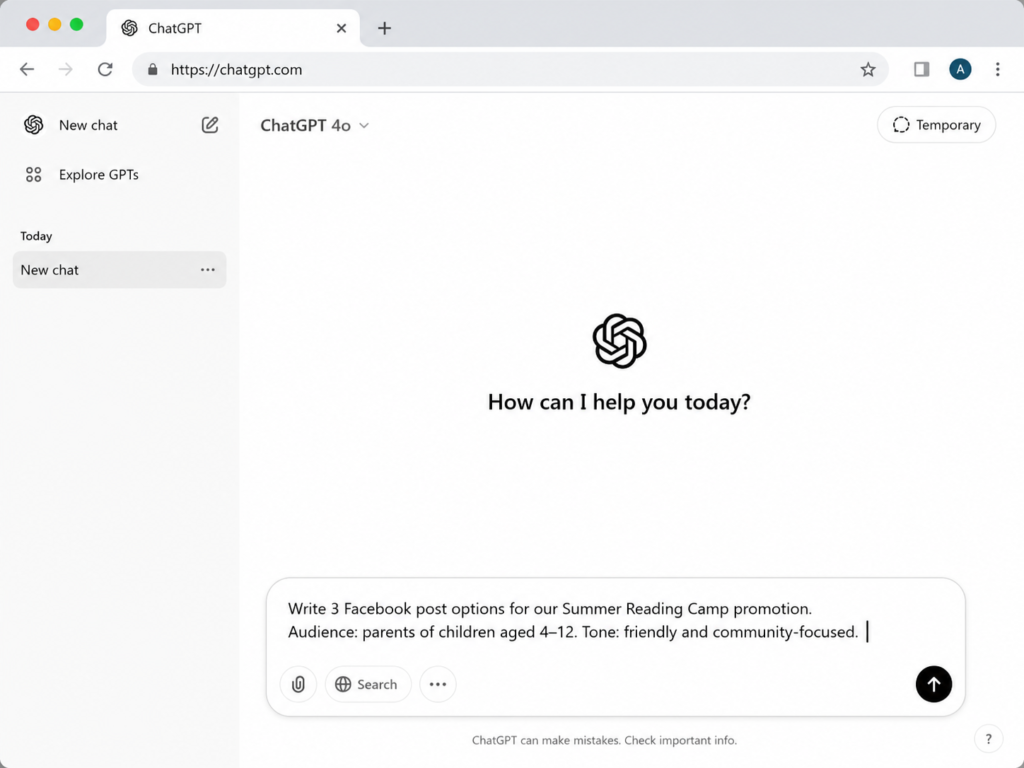
Where Unstructured Usage Creates Problems
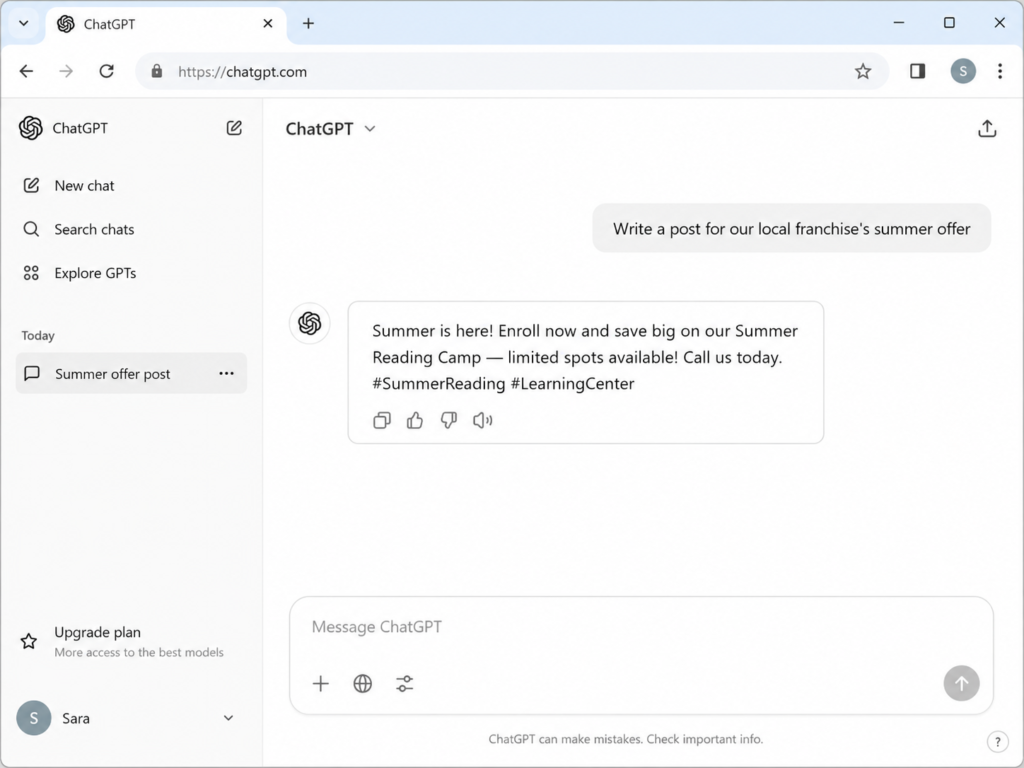
A vague prompt leaves too much to guesswork — the output looks polished but carries real compliance and brand risk.
Unstructured usage usually looks harmless. A local manager needs a fast post, so the prompt says, “Write a post about our summer offer.” The tool produces a clean draft. The manager posts it. The problem appears later.
In our AI implementation work with multi-location franchise teams, the failure point is almost never the prompt, it’s the missing approval step. In one case, a local manager at a regulated-industry franchise used AI to draft a review response that quietly included a refund promise no one at corporate had approved. It stayed live for two days before anyone caught it. The prompt was fine; what was missing was a checkpoint between the draft and the publish button.
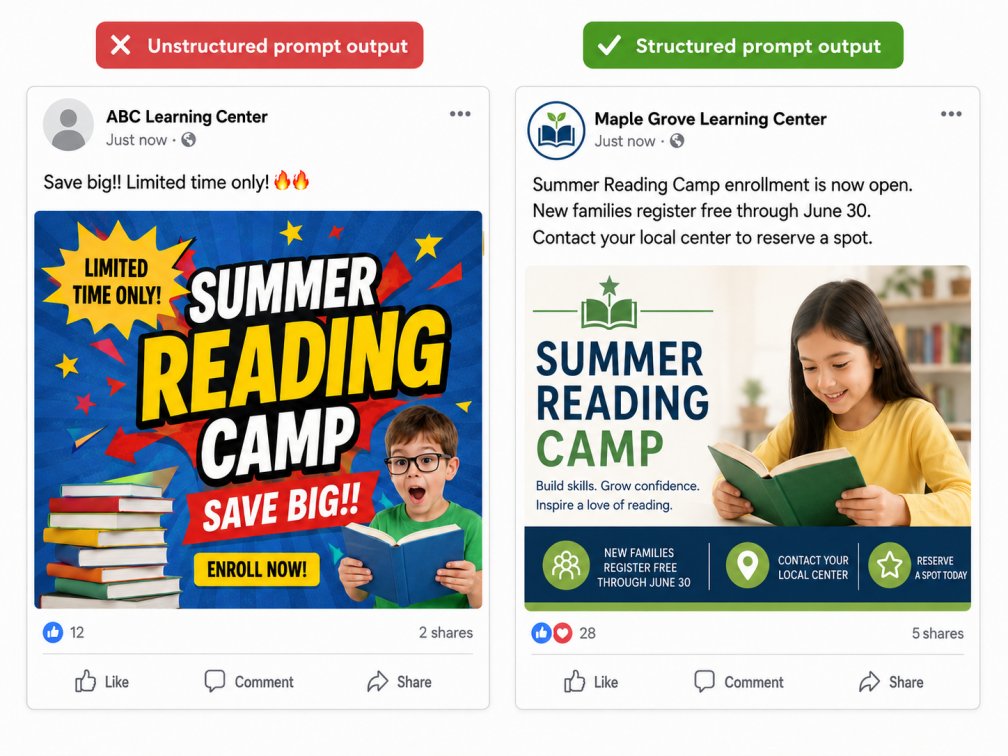
The most common franchise risks fall into five areas. The FTC’s advertising and marketing guidance says advertising claims must be truthful, not deceptive, and evidence-based. Its online review guidance also warns against soliciting only positive reviews or conditioning incentives on them.
| Risk area | Example | Risk level |
| Brand voice drift | One location formal, another uses slang — brand feels fragmented | Medium |
| Inaccurate local claims | AI invents hours, awards, service areas, or neighborhoods | High |
| Compliance exposure | Healthcare, financial, childcare franchises have strict language rules | High |
| Review response errors | Admitting fault, revealing customer info, promising unapproved refunds | High |
| Skipped approvals | Fast drafts create pressure to publish without brand or legal review | Medium |
How Franchise Marketing Managers Should Use Prompts
A franchise prompt should work like a content brief, not a casual request the same information a marketing manager would give a writer. Franchise prompts need more structure than general-purpose prompts because every output may affect brand standards, local accuracy, and approval responsibilities.
A weak prompt leaves too much room for guesswork, while a structured prompt gives local teams the details they need to produce on-brand, compliant content the first time.
| Structured Prompt Builder — ChatGPT | |
| Franchise / Location | [Your Franchise Name] — [City, State] |
| Content type | Facebook post (2 variations) |
| Audience | Parents of children aged 4–12 |
| Brand voice | Friendly, professional, community-focused |
| Approved offer | Free registration for new families through June 30 |
| Restrictions | No emojis, no pricing claims, no results guarantees |
| Approval level | ⚑ Local manager review required before posting |
| Output format | 2 options, under 120 words each |
| Generated Output (2 options — ready for local manager review) | |
| Option 1: Summer Reading Camp at [Franchise Location] is open for enrollment. New families can register at no cost through June 30. Spots are limited — contact your local team to reserve a place for your child. Option 2: Help your child discover the joy of reading this summer. [Franchise Location]’s Summer Reading Camp offers structured, engaging sessions for children ages 4–12. New family registration is complimentary through June 30. | |
A structured prompt with all nine elements produces clean, on-brand options — none contain unverifiable claims, missing disclaimers, or off-brand language.
Prompt Examples for Franchise Marketing Managers
These examples show structured prompts that pair content instructions with approval requirements.
Compliance-Sensitive Post
| PROMPT EXAMPLE — Compliance-Sensitive Post |
| Write a promotional post for [Franchise Name]’s [Location] in [regulated industry]. Promote [Service]. Tone: trustworthy and informative. No outcome guarantees or results-based claims. Include this required disclaimer: [Disclaimer Text]. This post requires legal team review before publication. Format for Facebook. Under 130 words. |
Paid Ad Headlines
| PROMPT EXAMPLE — Paid Ad Headlines |
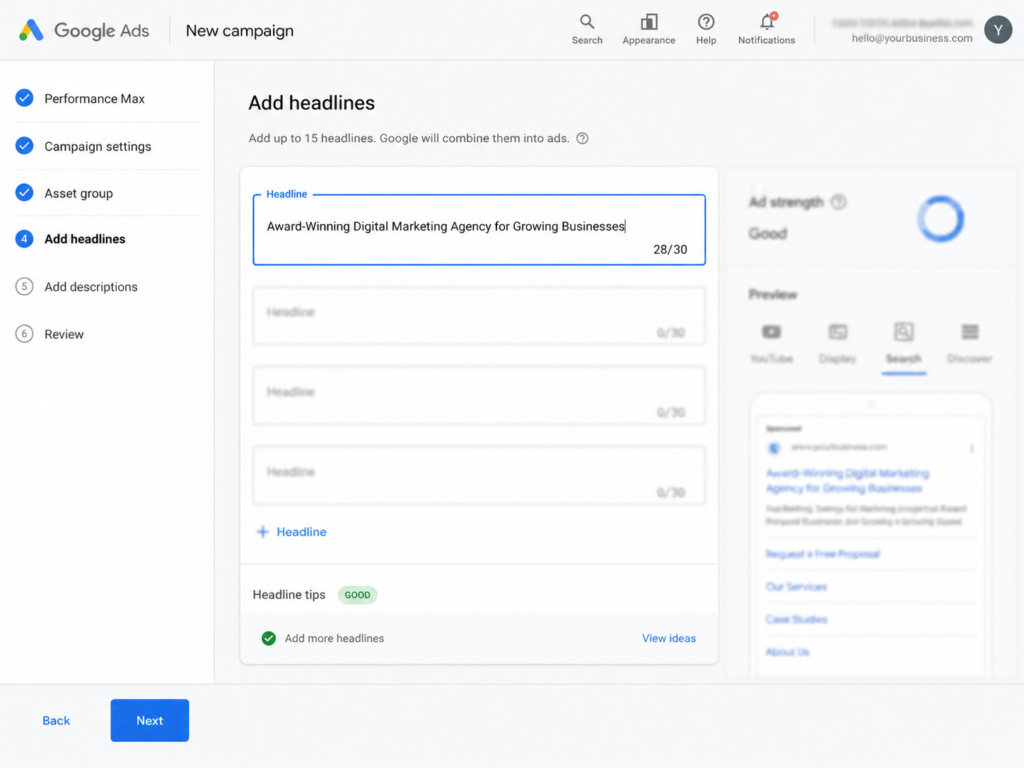
| Write three Google Ads headlines for [Franchise Name]’s [Campaign Name]. Each headline must be under 30 characters. Campaign promotes [Product/Service] with [Offer]. Target keyword: [Keyword]. Headlines should be direct and action-oriented. Do not use superlatives such as “best” or “number one” unless supported by a verifiable, documented claim. Approval level: corporate marketing approval required before launch. |
Review Response
| PROMPT EXAMPLE — Review Response |
| Write a response to this Google Review: [Paste Review]. Acknowledge the customer’s experience without admitting fault. Do not reveal private customer information. Do not offer refunds or discounts publicly. If the review is negative, invite the customer to contact [approved contact method]. Tone: professional and empathetic. Approval level: local manager review required before publishing. |
Why Approval Rules Matter
Prompts improve the quality of AI output; approval rules determine whether that output is appropriate to publish. This is where prompt usage becomes part of broader multi-unit business workflows, rather than a set of one-off content tasks.
Teams that want to turn this into a repeatable system can join Weam’s live AI implementation bootcamp for franchise marketing teams, which walks through identifying use cases, mapping workflows, and deciding where human review stays in the process.
In a franchise system, content is created by many people across locations, but customers experience the brand as one entity, a compliance failure at one location can create brand-level consequences. McKinsey’s 2025 State of AI survey found that 51% of organizations using AI had experienced at least one negative consequence, a reminder that defined human-validation processes matter as usage scales.
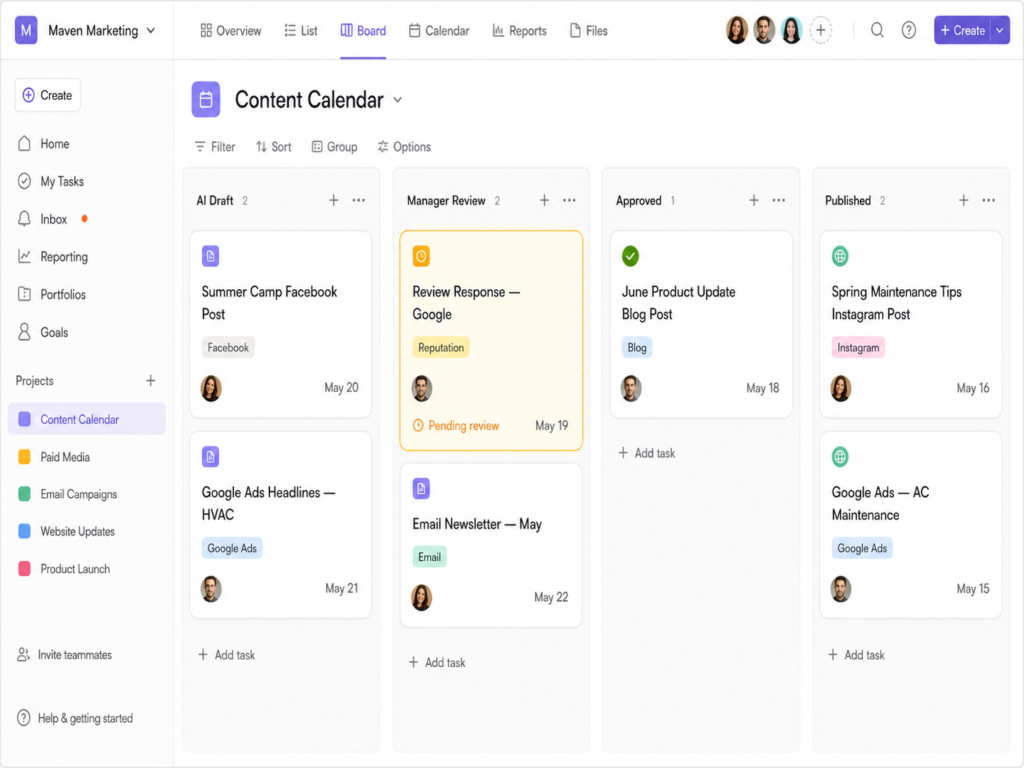
| weam.ai — Content Approval Workflow Summer Reading Camp post · [Location] | ||
| ✓ | AI draft generatedUsing approved prompt template · June 18, 9:14 AM | Complete |
| ✓ | Auto-check: restricted claimsNo superlatives, pricing claims, or invented facts detected | Passed |
| ◉ | Local manager reviewAssigned to: Local Manager · Pending since 9:16 AM | In Review |
| ○ | Schedule & publishWill publish to Facebook after manager approval | Waiting |
Every draft moves through a defined approval chain before publishing — the step and reviewer are set by content type and risk level, not by individual preference.
Example Approval Rules for Franchise Marketing Content
A tiered approval framework should be tied to content type and risk level. The approval rule should be chosen before the content is generated, not after.
| Approval level | When it applies |
| Corporate required | National campaigns, brand claims, slogons, awards, competitor mentions, paid media templates |
| Regional required | Multi-location promotions, regional event partnerships, co-op campaigns |
| Local allowed | Store hours, community posts, team introductions, review responses via approved templates |
| Legal review | Regulated industries, health or financial outcome claims, testimonials, child-related claims |
| Auto-reject | Unverifiable superlatives, competitor attacks, fake reviews, missing disclaimers, invented facts |
A Practical Prompt Framework for Franchise Teams
Every prompt written for franchise marketing should address these nine elements. Use this as a repeatable checklist before generating any content.
| ① GoalWhat the content should accomplish | ② LocationSpecific market, city, region, or store |
| ③ AudienceTarget customer and intent signals | ④ ChannelFacebook, email, Google Ads, local page |
| ⑤ Brand voiceTone, language rules, vocabulary guidelines | ⑥ Offer detailsApproved product, price, expiry date, terms |
| ⑦ Required disclaimersLegal language or mandatory brand statements | ⑧ Approval levelCorporate, regional, local, or legal review required |
| ⑨ Output formatVariations count, word count, character limit, checklist |
Filling in all nine fields — not just a few — keeps output consistent across team members and locations, and creates a record of what was requested for the approval review.
Want all nine elements pre-built into all 75 prompts? Grab the library →
Mistakes to Avoid
| ✗ | Ignoring local context. A prompt written for a suburban Phoenix location should not be identical to one written for a downtown Chicago unit. |
| ✗ | Not documenting effective prompts. When a prompt produces consistently good output, it should be saved and shared so teams do not rebuild the same work repeatedly. |
Get 75 Franchise Marketing Prompts, Ready to Adapt
A preview from the library:
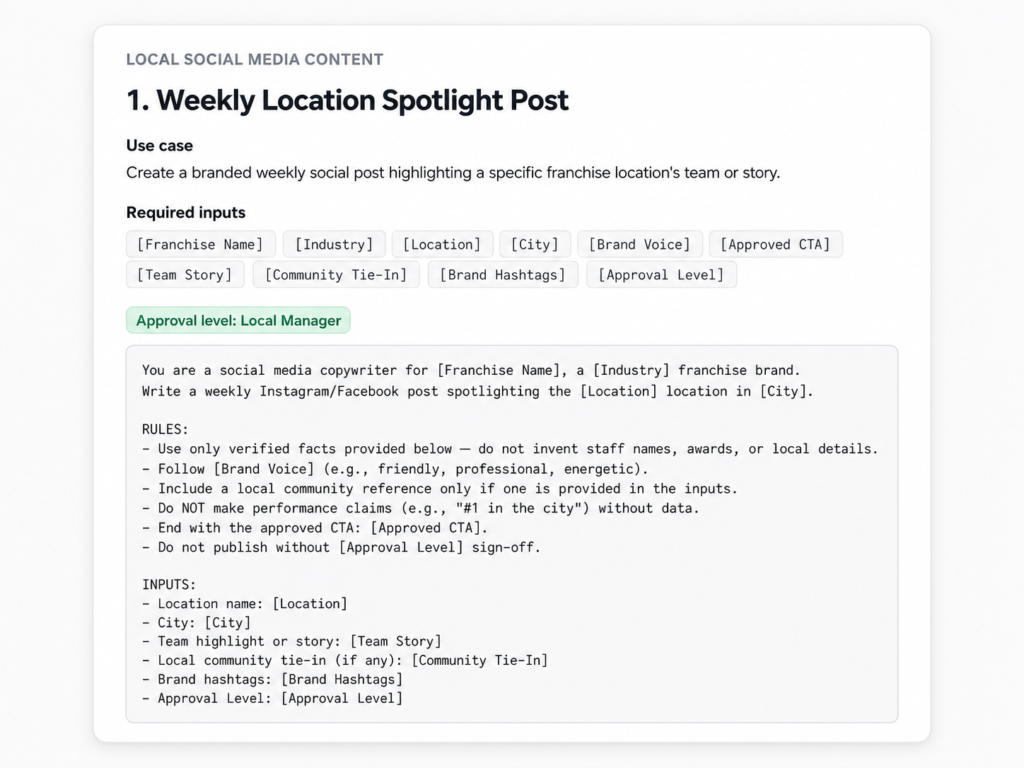
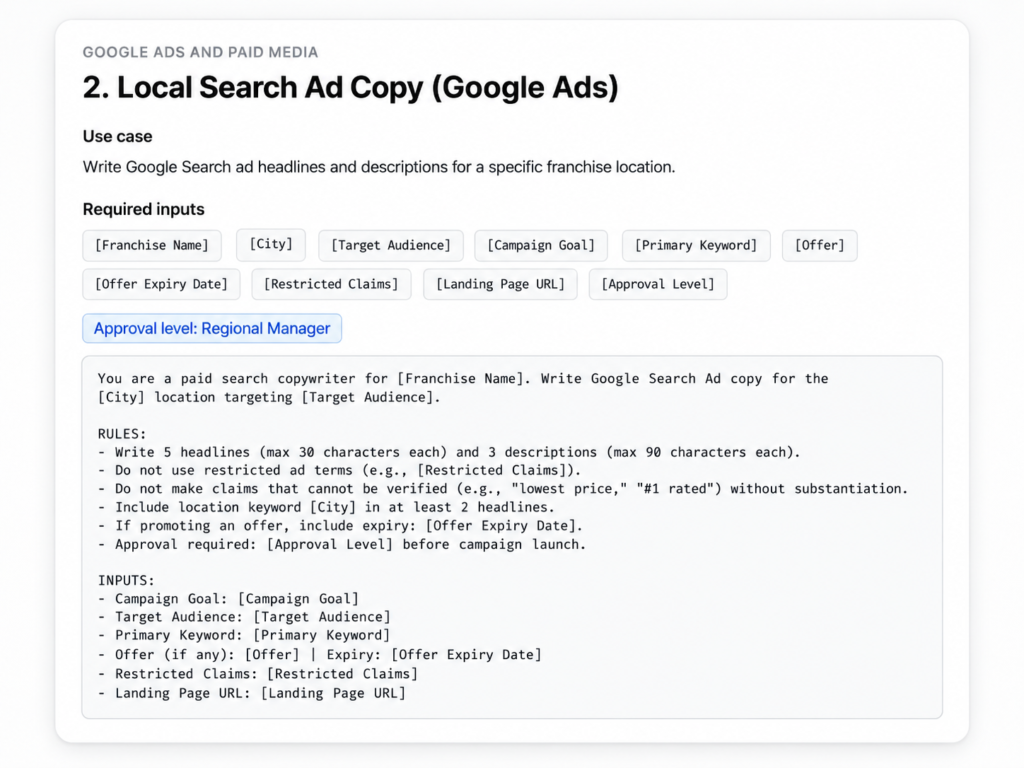
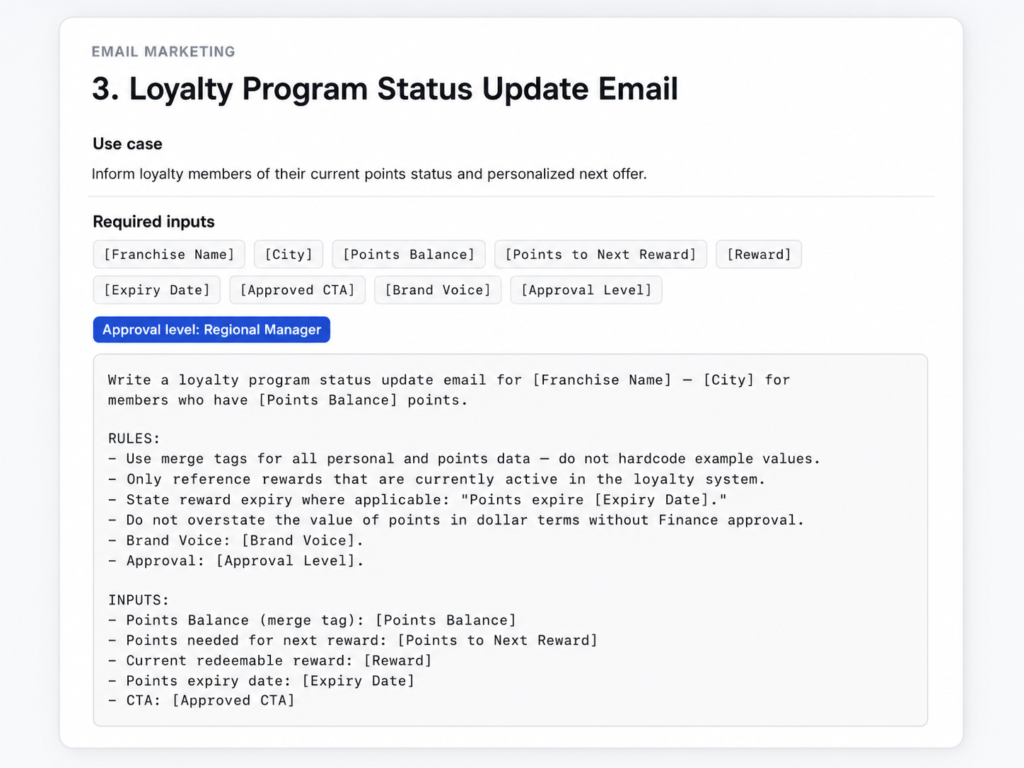
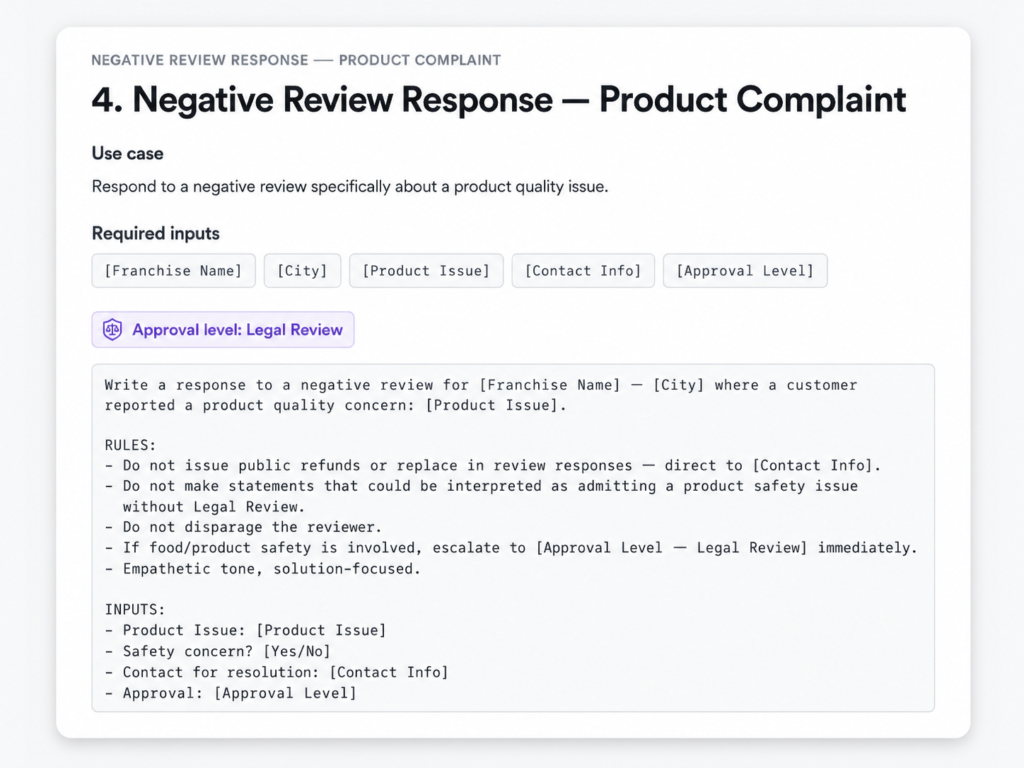
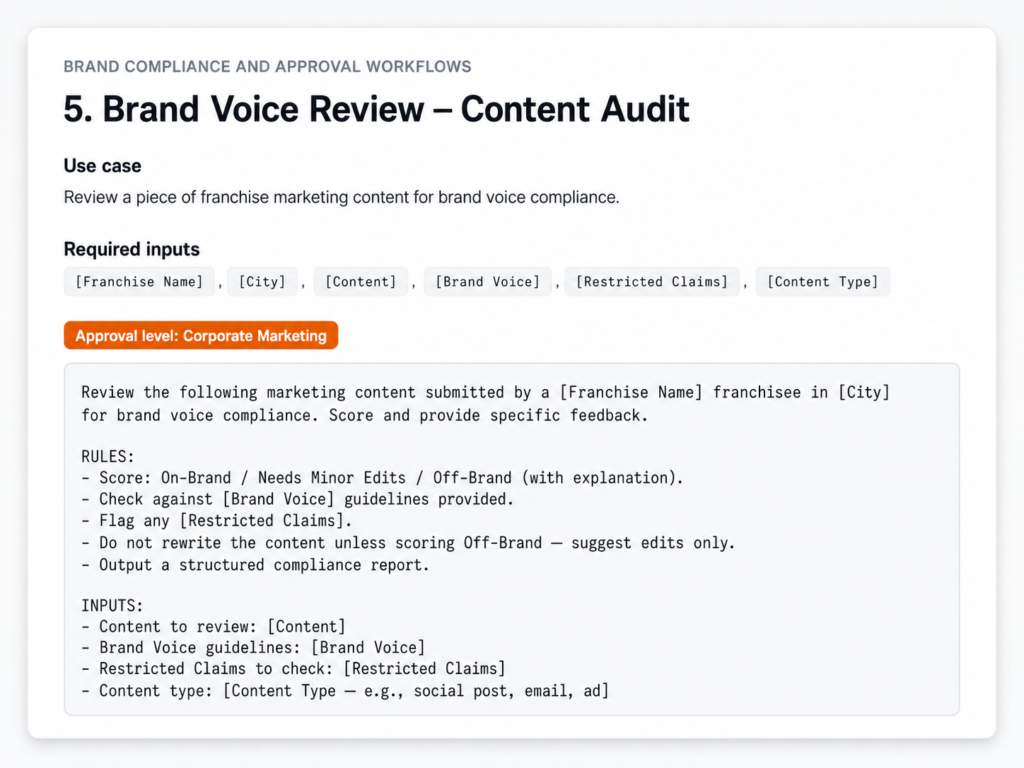
Each prompt should follow the nine-element framework described in this article.
Instant download. No sales call.
Weam cut marketing costs by 22% while launching campaigns faster across every location.
R Laws
Conclusion
LLM tools offer franchise marketing teams a real efficiency advantage — but only when prompts are structured and approval rules are part of the workflow, not an afterthought.
Franchise marketing managers who treat prompts as documented internal tools, with approval steps tied to content type and risk level, will produce content that’s faster to create, easier to review, and less likely to create brand or compliance problems.
The combination of structured AI prompts for franchise marketing and clear approval rules is not a constraint on speed. It is what makes speed sustainable across a multi-location system.
The fastest way to put this into practice: start from a finished library instead of a blank prompt.