Ask a franchise owner how they wrote last week’s Instagram caption, and the answer is often ChatGPT. The store manager who replied to that one-star Google review probably used it too, and so did whoever wrote the job ad at the Tampa location.
None of it went through HQ. There was no rollout, no training, no memo. People found tools that saved them twenty minutes and kept using them. That’s why AI governance for franchisors has moved from an IT side project to an operations problem.
It shows up in the data, too. Across industries, IBM’s 2026 Cost of a Data Breach Report found shadow AI involved in 43% of breached organizations, more than double the year before.
The questions that follow are uncomfortable. Which tools are people using? What are they pasting into them? Does the output match the brand, the current offers and the legal fine print?
The instinct is to clamp down, and that usually backfires. The better answer is governance built for how franchise networks actually work: locations keep moving fast, and HQ keeps control of what matters.
What Is AI Governance?
AI governance is the set of policies, permissions, systems and processes a company uses to control how AI is accessed and used. That’s the textbook version. The practical version is simpler: good governance gives clear answers to six questions.
- Which AI tools are approved?
- What data is off-limits?
- Which tasks can AI help with?
- Who can access which company knowledge?
- When does a person need to check the output before it goes anywhere?
- How does the company see what’s actually happening?
For a single-office business with one marketing team, those are manageable. A franchise system is a different animal. You’re governing HQ, regional teams, franchise owners, store managers and frontline staff across dozens or hundreds of locations.
Each group needs different things, and most of them don’t report to you. Franchisees own their businesses, which limits what HQ can simply require (more on that below). It also helps explain why so many companies are behind: in IBM’s 2026 report, 68% of breached organizations lacked AI governance capable of managing AI use or detecting shadow AI, up from 63% a year earlier.
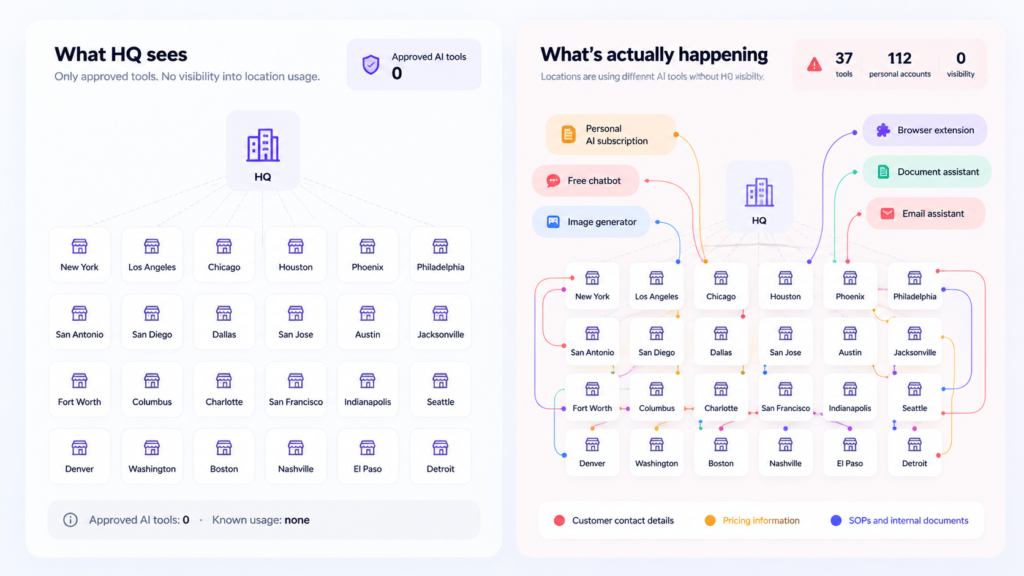
Shadow AI Is Already Happening Across Franchise Networks
Shadow AI is when employees or franchisees use AI tools without formal company approval, visibility or oversight. If you remember shadow IT (the Dropbox account marketing set up without telling anyone), it’s the same idea. It just spreads faster and is harder to spot.
In a franchise network, it looks completely ordinary:
- A franchisee uploads the operations manual to a free AI tool so they can ask it questions.
- A local marketer uses ChatGPT to write a promo for a discount HQ retired last month.
- A manager pastes a month of customer complaints, names and phone numbers included, into a chatbot to look for patterns.
- Twelve locations write twelve different prompts for replying to reviews.
Nobody here is trying to cause problems. They’re trying to get through a busy week. That’s the part most companies miss.
Shadow AI is often a usability problem disguised as a compliance problem.
If the approved way of doing something takes longer than opening a browser tab and typing into ChatGPT, people will open the browser tab. Every time.
Why an AI Policy Alone Is Not Enough
Most companies respond to shadow AI the same way: they write an AI policy for employees. A typical generative AI policy says something like this:
- Don’t share confidential or customer data.
- Only use approved tools.
- Review AI output before using it.
- Don’t publish anything sensitive without sign-off.
All reasonable. The trouble is that a policy describes the behavior you want without changing the conditions that produce the behavior you’ve got.
Picture a store manager who has read the policy. To follow it, she still has to pay for her own AI subscription, dig the latest SOP out of an email thread, paste chunks of it into a chat window, write a prompt from scratch and guess which model is best for the job. Or she can skip most of that and get something good enough in two minutes. You can guess which one happens on a Saturday afternoon.
An AI policy tells people what they should do. AI governance makes the right behavior easy to follow.
The policy still matters. It just needs a system behind it.
The 5 Biggest Risks of Uncontrolled AI Use
Good AI risk management starts with knowing what you’re actually worried about. For franchisors, it usually comes down to five things.
1. Sensitive data ends up in unapproved tools
Customer details, internal pricing, supplier terms, employee records, franchise agreements. Once that information goes into a personal AI account, you’ve lost track of where it lives and how it might be used. It’s also expensive when it goes wrong: breaches involving shadow AI averaged $5.39 million in IBM’s 2026 report, against a $4.99 million global average.
2. Locations publish off-brand content
AI writes quickly, but it doesn’t know your brand voice, which offers are live, what legal won’t allow or how marketing rules differ from one state to the next. The result is content that sounds fine and is quietly wrong.
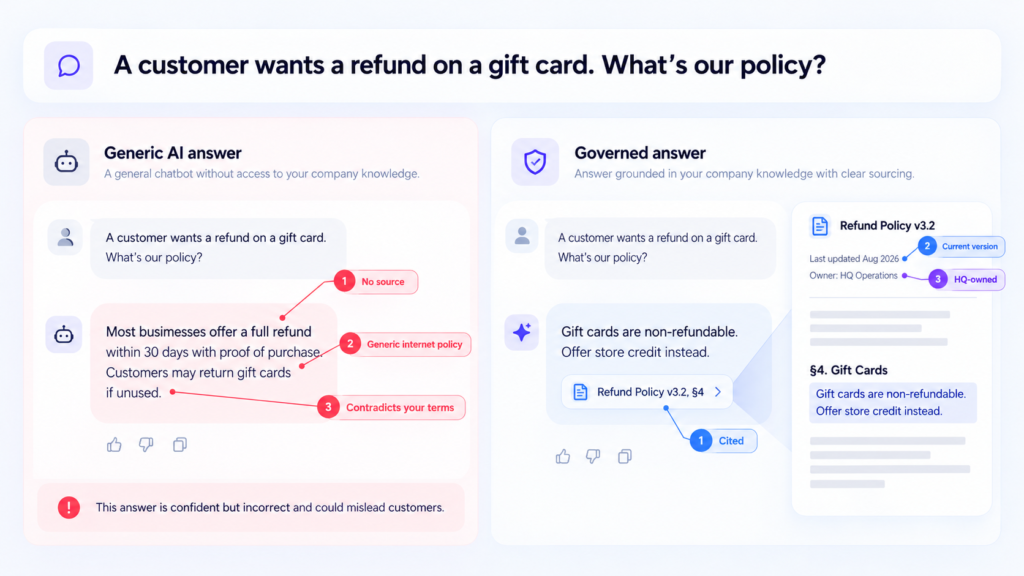
3. AI gives confident answers that are incorrect
A new manager asks a chatbot, “What’s our refund policy?” It answers instantly and clearly, based on what refund policies usually look like on the internet. Not yours. Nobody notices until a customer does.
4. Every location reinvents the same workflow
Fifty locations each work out their own way to write review replies, job posts, social captions and customer emails. That’s fifty versions of the same work, at fifty levels of quality, when a handful of shared automations for franchisors would cover most of it.
5. HQ can’t measure adoption or ROI
You may know AI is being used. You probably can’t say how many people use it, which locations rely on it, which workflows save real time or where the risks are. Without that, it’s hard to invest in AI with any confidence, and even harder to defend the spend.
The Franchise Questions to Take to Your Attorney
Most AI governance advice assumes you employ everyone you’re governing. Franchisors don’t, and that changes what HQ can actually require. None of this is legal advice. These are the questions worth putting in front of your franchise counsel before you roll anything out.
Can we require a specific AI tool? It depends on the franchise agreement. Many include a technology clause covering required systems, software and technology fees. Plenty were written before generative AI and are vague about it, so mandating a platform may mean an amendment or waiting for renewals.
Who owns the data a franchisee pastes into a chatbot? Customer lists, reviews and sales data often sit in a gray zone between franchisor and franchisee. Whose data it is shapes who carries the risk if it leaks.
Are we exposed when a location’s AI gets it wrong? If a franchisee publishes a false pricing claim or a discriminatory job ad written by AI, the complaint may name the brand alongside the franchisee. How much control you exercise over that content affects how strong that argument is.
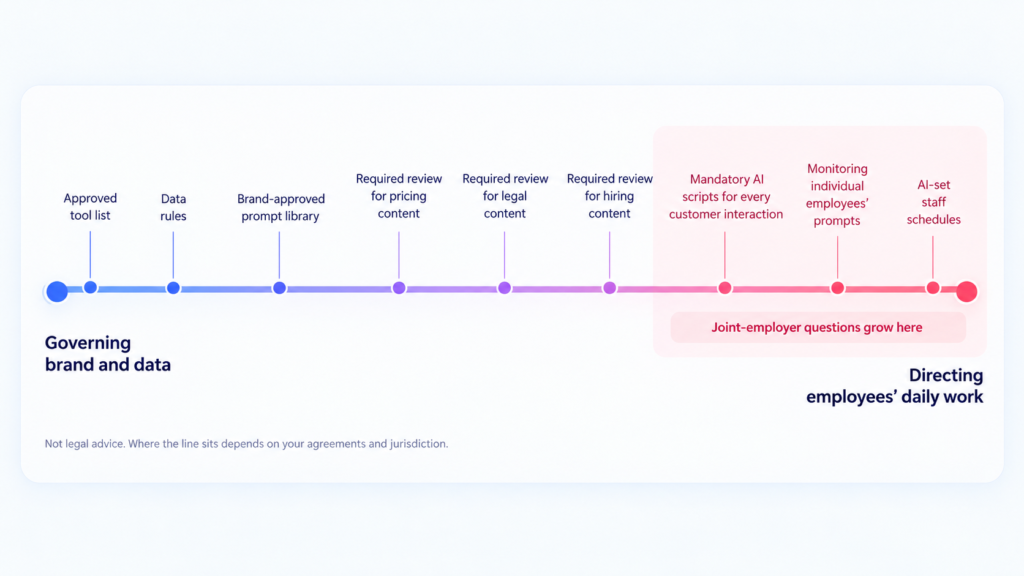
How far can we go before it looks like joint employment? This is the tension that makes franchisors hesitate. The more tightly HQ dictates how franchisee employees do their daily work, the stronger a joint-employer argument becomes. Governing brand standards and data is different from directing someone’s job, and that line deserves careful drafting.
Does a required platform change our FDD? A new mandatory system or technology fee usually has to be disclosed to prospective franchisees. Ask counsel what needs updating and when.
Regulation adds another layer, and it’s still moving. The EU AI Act treats AI used in hiring and employment decisions as high-risk, which matters for brands with European locations. New York City already requires bias audits for automated hiring tools. Colorado went further and repealed its 2024 AI Act outright: in May 2026 it replaced it with SB 26-189, a narrower law covering automated decision-making technology that materially influences decisions such as hiring. It takes effect January 1, 2027, so any franchise system using AI to screen or rank Colorado applicants has a real date to prepare for, even if enforcement waits on the attorney general’s rules.
What an AI Governance Framework Should Look Like
An AI governance framework doesn’t need to be a 40-page document. Formal standards like the NIST AI Risk Management Framework and ISO/IEC 42001 are worth knowing about, but for most franchise systems, governance comes down to six building blocks.
1. Approved AI tools
Decide which models and platforms people can use, then give them access so they don’t need personal accounts. The goal is fewer random logins, not fewer people using AI.
2. Approved company knowledge
Give AI controlled access to the material it should draw on: SOPs, policies, training documents, brand guidelines, product information and internal FAQs. That’s what fixes the refund policy problem.
3. Reusable, approved prompts
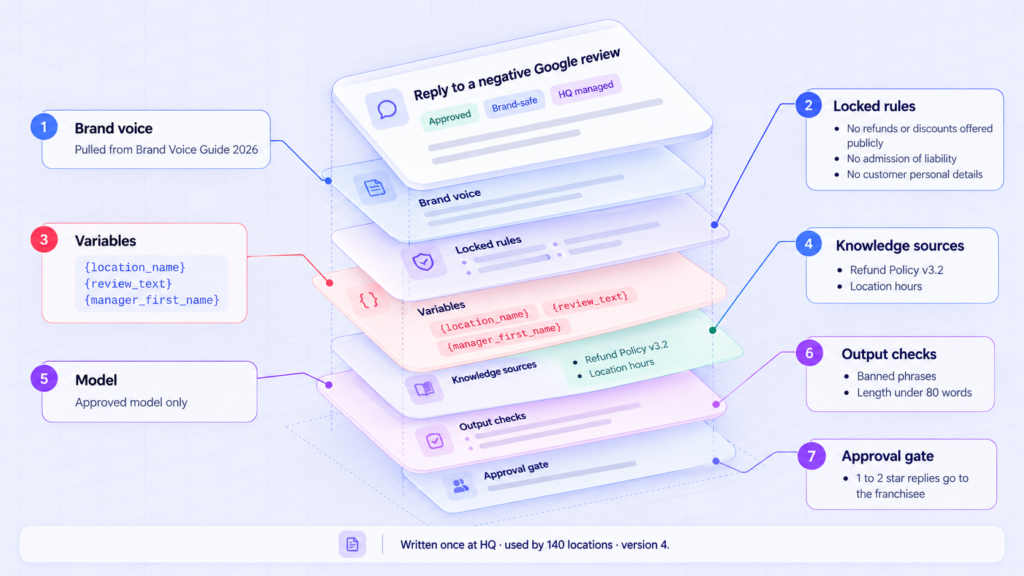
HQ builds prompts once for the work every location repeats: replying to a negative review, drafting a local promotion, summarizing feedback, writing a job post, turning an SOP into a checklist. For marketing teams, prompts with built-in approval rules keep speed and brand control together.
4. Role-based access
Not everyone needs everything.
| Role | What they can access |
|---|---|
| HQ | Company-wide knowledge, settings and reporting |
| Regional manager | Knowledge and reporting for their region |
| Franchisee | Operational resources, brand assets and approved workflows |
| Location employee | A small set of everyday workflows |
5. Human review for high-risk tasks
Pricing claims, legal responses, hiring content and anything regulated shouldn’t go straight from AI to the public. The flow is simple: AI drafts, a person reviews, someone approves, then it’s published.
6. Usage monitoring
Track active users, the most-used workflows, usage by location and time saved. That’s how you find the wins worth scaling and the gaps worth fixing.
How the pieces fit together
Each risk from earlier maps to a building block, and each block maps to a function in the NIST AI Risk Management Framework.
| Risk | Building block that addresses it | NIST AI RMF function |
|---|---|---|
| Sensitive data in unapproved tools | Approved tools, role-based access | Govern |
| Off-brand content | Approved prompts, human review | Manage |
| Confident but wrong answers | Approved company knowledge | Manage |
| Every location reinvents workflows | Approved prompts | Manage |
| No visibility into adoption or ROI | Usage monitoring | Measure |
NIST’s fourth function, Map, is the Discover step in the plan below: understanding where AI is already in use before deciding what to control.
How to Control AI Without Slowing Franchisees Down
This is the part that decides whether governance works or becomes one more thing people route around.
Make the approved option the easiest one. If the approved tool gets a usable answer faster than a free chatbot, convenience does most of the enforcing.
Standardize repeatable work, not every thought. Lock down customer replies, promotions and hiring content. Leave brainstorming alone.
Give teams freedom inside guardrails. Franchisees know their local market better than HQ does. Let them experiment with ideas and tone, and draw firm lines around sensitive data and what gets published.
Keep one source of truth. When every location keeps its own copy of the brand guidelines, some copies are out of date. One shared, current source means AI answers from the right version.
Match approvals to the risk. Brainstorming subject lines and publishing a pricing claim shouldn’t go through the same process. If they do, people start skipping it for both.
Centralize the guardrails. Decentralize the creativity.
From AI Policy to a Governed AI Setup
Today, a typical franchise employee’s AI setup is a personal ChatGPT account, brand guidelines in Google Docs, an SOP buried in their downloads folder and a few favorite prompts in a notes app. HQ can see none of it.
A governed setup pulls those pieces together: approved models, AI that answers from company knowledge, shared prompts and agents, permissions by role and visibility into usage. Some franchisors build this with an internal team. Others bring in a partner to build and run it. Either way, that’s where governance stops being theoretical. A policy on paper can’t change what someone does at 6 p.m. on a Friday. A setup where the right knowledge and prompts are already waiting can.
A Simple 5-Step AI Governance Plan for Franchisors
You don’t have to solve everything at once. Here’s a practical order to work in.
Step 1: Discover. Find out what’s already happening. A short, anonymous survey works well: which tools are teams using, what for and what information goes into them? Expect the answers to be broader than you’d guess.
Step 2: Define. Set the basics: approved tools, prohibited data, acceptable uses and which tasks need human review. Run it past counsel using the questions above, and keep it short enough that a store manager will read it.
Step 3: Centralize. Bring company knowledge, prompts and AI assistants into one controlled environment. Plan the switchover for franchisees already paying for ChatGPT or Claude: give them a cutover date and decide whether HQ covers access from then on, so nobody pays twice.
Step 4: Enable. Train franchisees on workflows that help them, not just on the rules. Franchise networks have a real edge in AI adoption because one good workflow can roll out to every location. Show a manager how to answer three reviews in five minutes and you’ll get more buy-in than any policy memo.
Step 5: Measure. Track adoption, time saved, workflow usage, location participation and output quality. Then adjust. Governance isn’t a one-time project.
How Weam Helps Franchisors Put AI Governance in Place
Weam is an AI implementation partner for franchise and multi-unit businesses. Instead of handing HQ another tool to configure, the Weam team designs, builds and maintains the governed setup for your network. The product views in this article are illustrative mockups of the kind of setup Weam builds. It includes:
- Prompt libraries, training and governance guidelines built around your brand, so every location uses AI the same way
- AI grounded in your operations playbook and brand standards, so answers come from your documents
- Model choices reviewed and approved with your legal or operations team during setup
- Role-based permissions across HQ, regions and locations
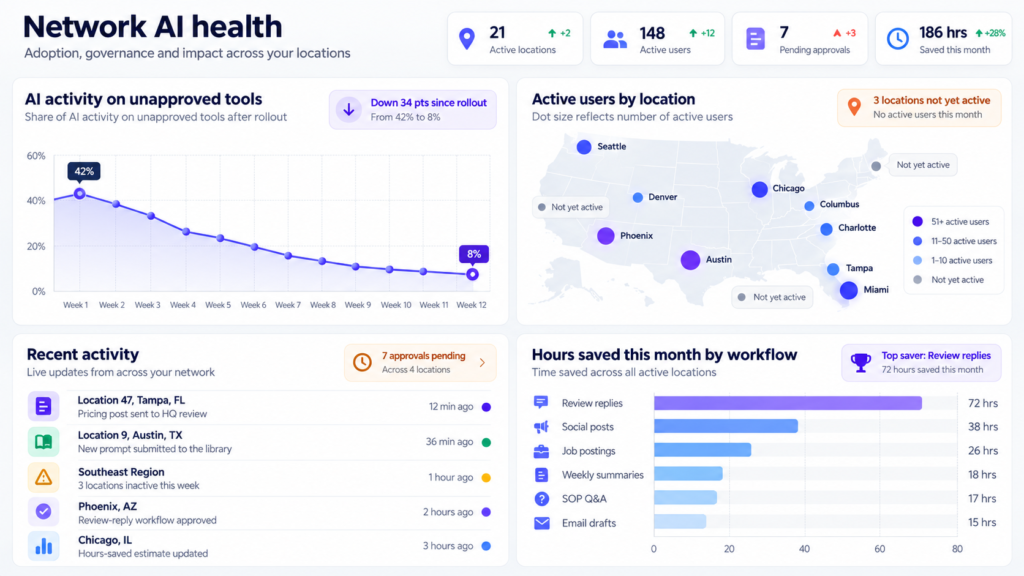
- Usage tracking that shows which teams use AI and which tasks save the most time
That covers the operational side of governance. It doesn’t replace your franchise counsel, a model-level risk assessment, the audit logs a regulator may ask for, your data retention and deletion policy or due diligence on the AI vendors themselves. Those still need an owner at HQ, and naming them early saves a scramble later.
Once the guardrails are in place, the next step is putting AI to work where locations lose the most time and money. Our guide to 10 AI workflows that stop revenue leaks picks up from there.
Want to see what a governed AI rollout could look like across your locations? Book a demo call.
Final Takeaway: Don’t Fight AI Adoption. Govern It.
Franchisees using AI isn’t the problem. They found tools that save them time, and that’s a good thing. The problem is AI use that nobody can see, guide or measure.
So the goal shouldn’t be to stop people from using AI. It should be to give them a faster, safer, company-approved way to use it.
The organizations that get AI governance right won’t be the ones with the longest AI policies. They’ll be the ones where the approved way to use AI is also the easiest way.
FAQs
What is AI governance for franchisors?
It’s the set of policies, permissions and processes a franchisor uses to control how AI is used across HQ and franchise locations. It covers approved tools, data rules, access by role, human review and usage monitoring, shaped around what the franchise agreement allows.
Can a franchisor require franchisees to use a specific AI tool?
It depends on the franchise agreement. Many include a technology clause covering required systems and fees, but older agreements may not mention AI. Check with franchise counsel, and remember that a new required platform may need to be disclosed in the FDD.
What is shadow AI?
Shadow AI is the use of AI tools without the company’s approval or visibility, such as pasting internal documents into a personal chatbot account. It’s usually driven by convenience, not bad intent.
What should a franchise AI policy include?
At minimum: approved tools, data that must never be shared, allowed use cases, when human review is required and who to ask when something’s unclear. Keep it short and use real examples.
How can a company stop employees from using unapproved AI tools?
Bans rarely work on their own. Offer an approved option that’s faster and more useful, with company knowledge and ready-made prompts built in, then monitor usage and follow up where gaps show.
What is an AI governance framework?
It’s a structured approach to managing AI use. A practical one covers approved tools, approved knowledge, reusable prompts, role-based access, human review for high-risk tasks and usage monitoring. Those map onto the Govern, Map, Measure and Manage functions of the NIST AI Risk Management Framework.