88% of Businesses Are Using AI Wrong. And Franchises Are Secretly Built to Win
Notion just released one of the most honest AI reports I’ve read in a while. They surveyed 6,118 people across 10 global markets to figure out where companies actually are in their AI journey, not where LinkedIn posts claim they are.
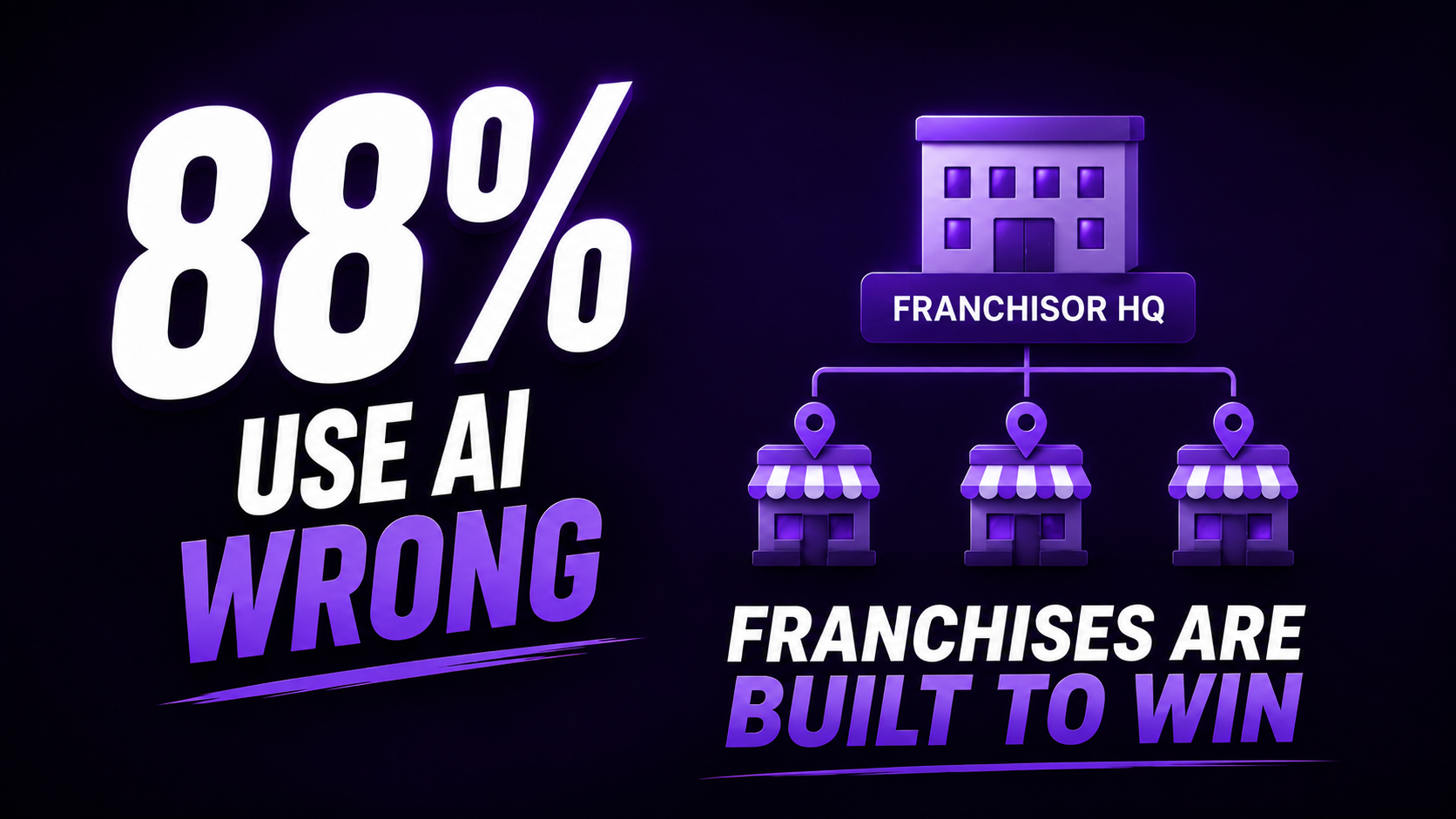
The headline number: 88% of companies are still using AI as a personal chatbot. Drafting emails. Summarizing documents. Brainstorming ideas. Useful, sure. But only 12% have AI actually running workflows in their business. And just 2% have AI operating critical processes end to end.
When I read that, my first thought wasn’t “companies are behind.” It was this: if you run a franchise or multi-location brand, this report is the best news you’ve received all year.
Let me explain why.
The 4 levels of AI maturity, in plain English
Notion structures the report around a four-level model. Here’s my translation after working inside these levels with real businesses:
Level 1: AI as a thought partner (57% of companies). Someone on your team opens ChatGPT, asks it to write a caption or clean up an email. No connection to your business data. This is where most of the world lives
Level 2: AI as an assistant (31%). AI is connected to your systems and context. It knows your brand voice, your documents, your customer data. Tasks get done faster because the AI isn’t starting from zero every time.
Level 3: AI as teammates (10%). This is where it gets interesting. AI agents run recurring workflows on their own, with humans reviewing at checkpoints. Think of a lead follow-up sequence that runs itself, or a reporting workflow that compiles and sends itself every Monday.
Level 4: AI as teammates (2%). AI runs complex, business-critical processes with real autonomy. Very few companies are here, and most don’t need to be there yet.
The important part is the shape of the value curve. It’s not linear. The jump from Level 2 to Level 3 is where the real returns start showing up, because you stop saving minutes per person and start reclaiming entire workflows per team.
A quick story about what these levels look like in real life
A while back we worked with a franchisor whose marketing team was classic Level 1. Everyone had a ChatGPT tab open. Ad copy, captions, email drafts. Individually helpful, collectively invisible. Every location was getting roughly the same generic ads because the AI knew nothing about any of them.
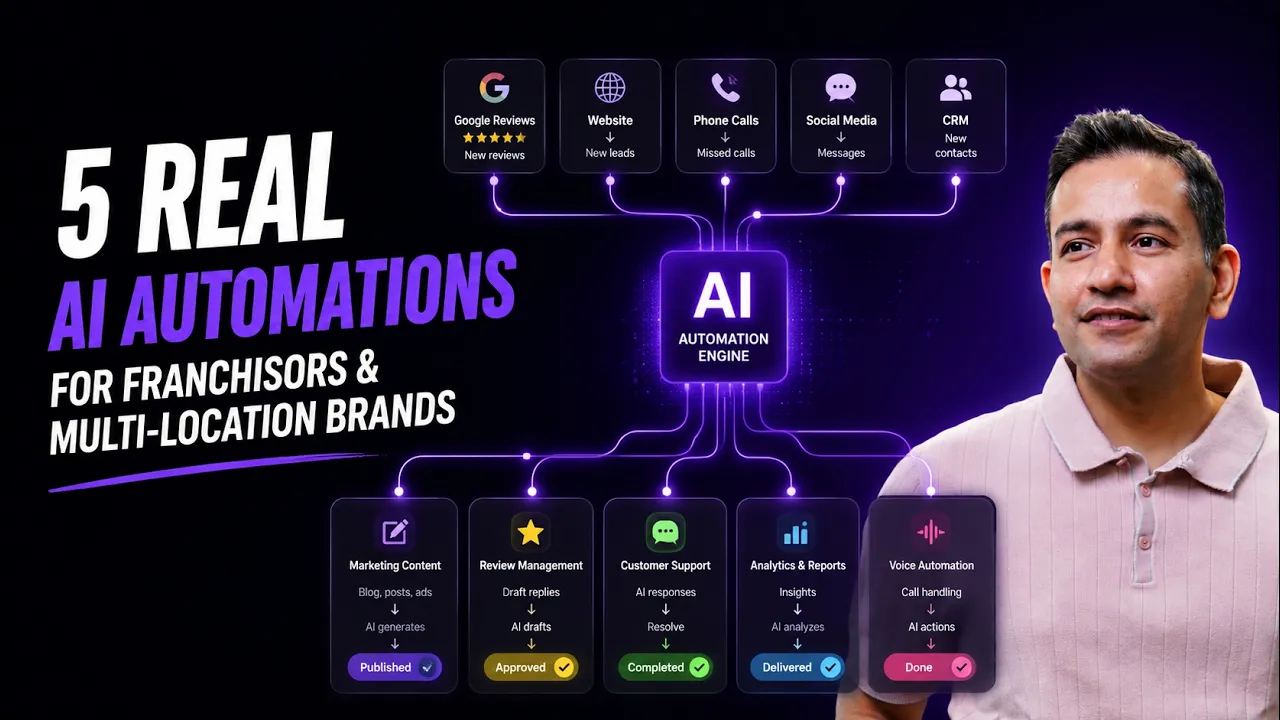
The shift happened when we stopped asking “how can each person use AI” and started with the boring part first: clean location data. We built a small system that pulls together, for every single location, reviews, CRM metrics, POS data, Google Business Profile, the website, and the manual stuff that doesn’t live in any system.
Once every location had its own data profile, AI-generated ad copy stopped being generic and started being strategic. Now you can build hypotheses per location. A location running at full capacity gets ads pushing premium services, because they don’t need more volume, they need better margins. A location with open capacity gets the opposite: entry-level offers designed to fill the calendar. Same brand, same system, completely different message per unit.
I’ve broken down this whole approach in detail in our multi-location PPC blog, including a video walkthrough, if you want to see how it works step by step.
That’s a Level 1 to Level 3 jump on one workflow. Not the whole business. One workflow. And that’s the pattern I keep seeing: you don’t transform a company, you transform one recurring workflow at a time.
Why franchises are structurally built for Level 3
Here’s the part of the report that made me want to write this post. When you look at who’s actually reaching Level 3 and 4, the profile looks almost exactly like a franchise system. Three data points stand out.
1. You’re the right size
Mid-market companies lead adoption at 17%, while enterprise trails at just 7%. Big companies have more budget, but they also have more committees, more legacy systems, and more people who can say no.
Emerging franchisors and multi-unit operators sit in the sweet spot. You’re big enough to have repeatable processes worth automating, and small enough that a decision made this quarter can be live before the next one.
2. You already have centralized decision-making
This one is huge. Owner and CEO respondents are more than 6 times as likely to be operating at Level 3 or 4 compared to individual contributors. 39% versus 6%. AI transformation is a top-down game.
And franchising is the most top-down business model there is. One decision at the franchisor level deploys across every unit. Your franchisees don’t need to independently figure out AI. They need you to hand them a system that works. That’s not a limitation, that’s leverage. A 200-person company needs 200 people to change behavior. A 40-unit franchise needs one head office to build it once.
3. Your business IS repeatable workflows
Look at where usage actually grows as companies mature. Automating repetitive tasks jumps 18 percentage points. Routing work across tools jumps 15. The mature companies aren’t using AI to write better, they’re using it as the connective tissue between systems.
Now think about what a franchise actually is. It’s a library of standardized, repeatable workflows: local marketing, franchisee onboarding, weekly reporting, compliance checks, customer follow-up. The thing mature organizations struggle to build, standardization, you built years ago. It’s called your operations manual.
Most businesses have to invent their SOPs before they can automate them. You just have to activate what’s already there.
The two traps I see kill franchise AI rollouts
I’d be lying if I said this was easy. The same report shows exactly where things go wrong, and both failure modes hit franchise systems harder than anyone else.
Trap 1: Tool sprawl. “Too many AI tools” is the fastest-growing complaint among advanced organizations, up 14 percentage points at Level 3 and 4. One respondent put it perfectly: too many options exist, but none fits the actual workflow.
Now multiply that across 40 locations. If every franchisee picks their own tools, you don’t have an AI strategy, you have 40 experiments and zero brand consistency. We’ve seen prompt libraries solve part of this for marketing teams, giving every location the same proven inputs instead of everyone freelancing. The principle is the same across the board: one system, one governance layer, one way of doing things.
Trap 2: The readiness gap. Across every maturity level, decision makers say they’re investing in AI faster than employees can keep up. And it gets worse as you advance, climbing from 48% at Level 1 to 68% at Level 4.
This is the trap I see most often. A franchisor buys a tool, announces it in the monthly newsletter, and six months later adoption sits at 15%. The tool wasn’t the problem. There was no training, no rollout plan, no one accountable for making it stick at the unit level. In franchising, a tool that head office loves but franchisees ignore is worse than no tool at all, because now you’ve spent money proving that “AI doesn’t work here.”
The franchisor playbook, based on what Level 3 companies actually do
The report also shows what separates companies that break through. Three things, and they map cleanly to how franchisors already think:
Integrate with existing systems first. The single biggest gap between mature and immature companies is integration, up 18 points. Don’t bolt AI on the side. Build it into the workflows your locations already run.
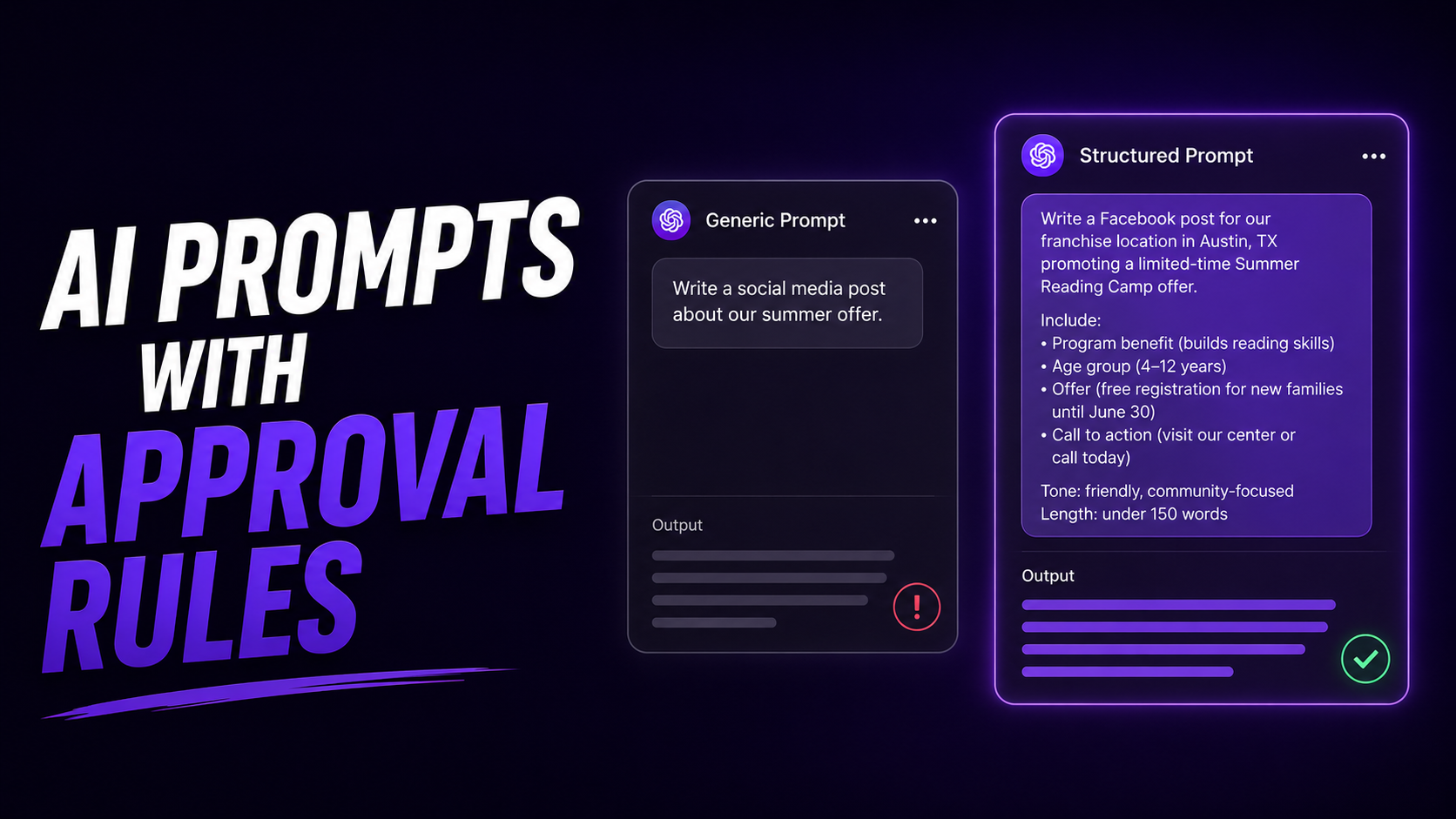
Build governance before you scale. Mature companies are 16 points more likely to have oversight and governance in place. For a franchise, this is non-negotiable. Brand consistency across units depends on it. Decide what AI can and can’t touch before location number one goes live, not after location number twelve does something off-brand. Governance doesn’t have to mean a 50-page policy document either. It can be as practical as rules inside your prompt library about who approves a prompt before locations can use it. I’ve written about how we structure prompt library approvals if you want a working model to copy.
Measure like a franchisor. Level 3 and 4 companies measure quality metrics, workflow metrics, and financial impact. The immature ones rely on anecdotes about time saved. You already know how to do this. You track AUV, you compare unit economics across locations. Treat AI ROI the same way: per location, comparable, reportable. If you can’t put it on the same dashboard as your unit P&L, it’s not ready to scale.
The window is open right now
Back to that 88% number. Almost nine out of ten businesses, including your competitors, are stuck using AI as a fancy chatbot. The 12% who broke through didn’t get there by buying more tools. They built systems.
Franchising already thinks in systems. You have the SOPs, the centralized decision-making, and the repeatable workflows that mature AI adoption requires. Structurally, you’re ahead. Most franchisors just haven’t activated it yet.
That activation piece, going from scattered individual usage to workflows that actually run, is exactly what we do at Weam. We work with franchisors and multi-location brands as their AI implementation partner, from picking the first workflow to training the teams who’ll run it. And if you’d rather talk it through than take an audit, book a call with us. It’s a conversation, not a pitch.